Tag: Panama

  • Portobelo

    Portobelo

    We left Bluefield mid-morning on December 26. Skies were dramatically overcast in a thousand vibrant shades of gray in the way that rainy Panama does so well. Leaving the harbor, we encountered a Ngöbe fisherman in a cayuco. He had several freshly caught lobsters and a couple of small fish that he clearly wanted to sell to us. We slowed down so he could come alongside. After a speedy transaction, I took the catch down below for cleaning. That was a bad idea.

    Back to the Caribbean

    The seas built as we headed into the open Caribbean for the first time since June. We had gotten spoiled in the archipelago where waters were well protected. Through the galley portlight I saw another brave fisherman paddling his cayuco in two meter swells. (Locals had told us that protected harbor waters were over fished; they have to go far out for a good catch.) I was starting to feel the effects of the swell combined with the smell of the fish in the galley. I rarely get seasick, but this time the queasiness set in quickly. 

    We sailed close to the coast, where eddies of wind and current gave us a fairly easy downwind sail. A large pod of dolphins accompanied us for hours. 

    Accompanied by playful, curious dolphins.

    Our relatively benign sail stopped abruptly when the wind died late in the afternoon. We headed offshore a bit in hopes of finding some wind. We got a little more wind than we wanted in and around numerous squalls. Waves heights were now two to three meters. The sea reminded us that we hadn’t stowed and battened down some things as well as we should have. We scrambled to keep everything in place.

    After beating into the wind all night and all day the next day, we were getting tired. By midnight the second night we were approaching Colon, the main city on the Caribbean side of the canal. This meant we had to sail across the area where dozens of big ships wait at anchor or maneuver to take on a pilot for their canal transit. It’s scary sailing through such a concentration of big vessels at night—making sure we stay out of their way as they move around unpredictably. Modern navigation equipment makes collision avoidance a lot easier than it used to be, but staring at a screen too long in big seas carries its own risks, especially when tired. This time it was Joe’s turn to get queasy. 

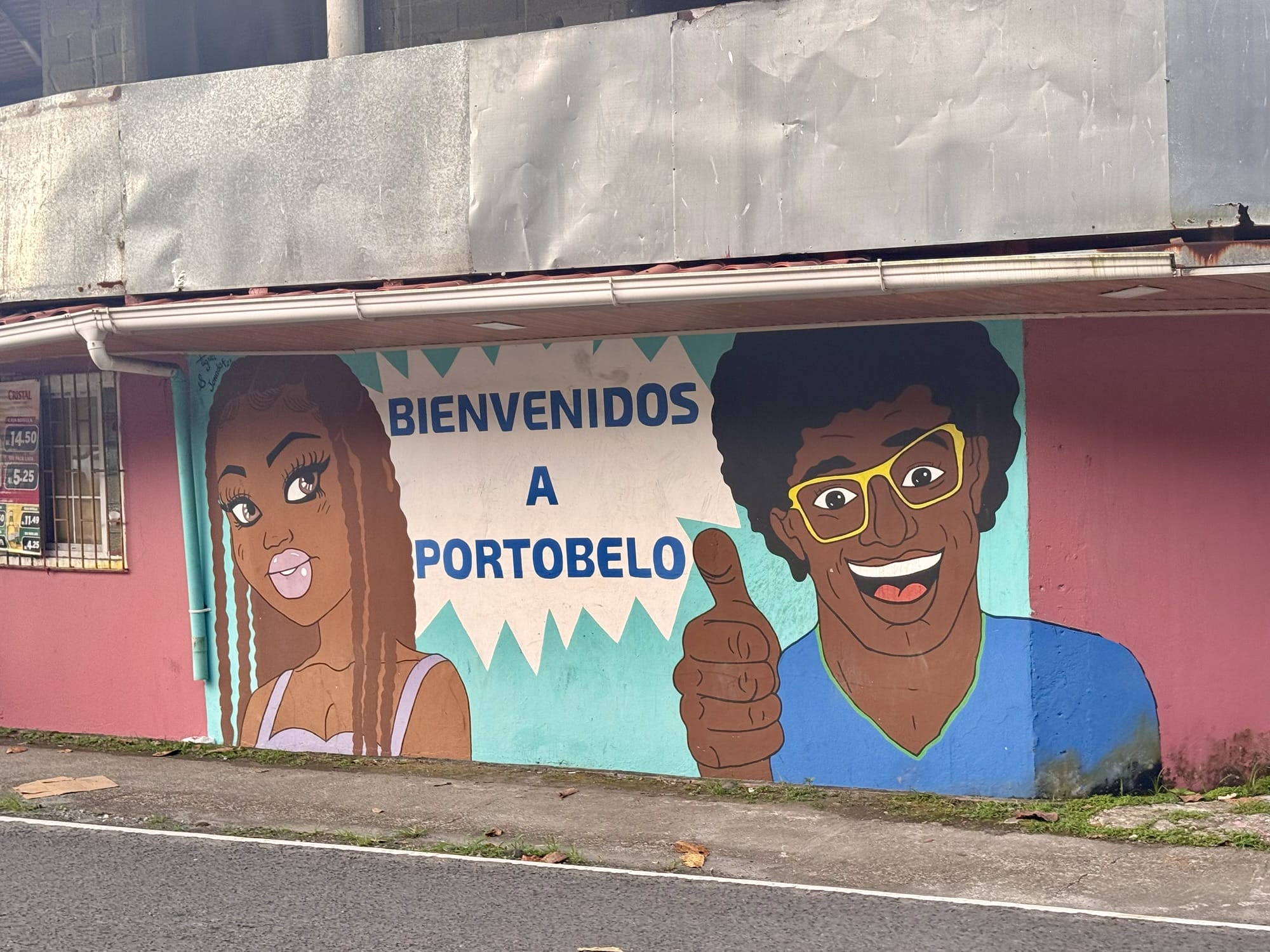
    Portobelo

    We arrived in Portobelo Sunday morning, salty and exhausted.

    The small town is nestled in a picturesque harbor surrounded by hills and ruins of many seventeenth and eighteenth century fortresses. You really feel the history here, and quite a history it is.

    Christopher Columbus discovered the harbor on his fourth voyage in 1504. For several centuries Portobelo was the most important port for shipping New World gold and silver back to Spain. Treasure attracted pirates. Francis Drake died of fever here in 1596. Henry Morgan looted Portobelo in 1668. A customs house, still standing, collected duties from ships delivering supplies from Europe.

    One of the fortresses guarding the harbor.
    Defenses against pirates and other enemies.

    Today Portobelo is a center of the Afro-Caribbean “Congo” culture along Panama’s central Caribbean coast. Congo is a mixture of music, costumes, and dance with African roots.

    Local Congo art

    Portobelo is a simple, unfancy town. Centuries-old ruins are everywhere. Homes generally don’t appear wealthy but show a lot of creativity in design and decoration.

    Homes are not fancy but very creative.
    Portobelo’s School of Rhythm

    El Cristo Negro

    In the Church of San Felipe, the Black Christ is revered by locals and attracts a large annual gathering of pilgrims. The origin of the Black Christ is unknown, but locals have plenty of legends about how the figure arrived mysteriously on their shore and miraculously put an end to a deadly cholera outbreak.

    Iglesia de San Felipe

    Red Devils

    The Diablos Rojas (“Red Devil”) public transportation buses are a cultural icon of Panama. They are retired American school buses hotrodded with elaborate murals, chrome trim, lights, and music. They have largely been replaced by modern buses in the bigger cities, but here along the small coastal towns they remain in active use. There’s a lesson here: if you can’t afford luxury, you can at least use your creativity to make it fun.

    Casa Vela

    Portobelo’s history and culture are important and fascinating, but for us the highlight of our visit was meeting people. On arrival in the harbor we dropped anchor and immediately fell asleep. After several hours of napping we rowed over to a small restaurant on the water with a dinghy dock.

    As strangers in a new town, we never know what to expect in these situations. This was one of those times when the cruising lifestyle really pays off—we put ourselves out there in the world, and the world greets us with the best that humanity has to offer.

    Casa Vela is a cute, tiny waterfront restaurant. Francesco, the Italian owner, immediately greeted us as if we were old friends. And indeed we became fast friends with him and his Panamanian girlfriend Gabriella. Over the course of the next several days we met numerous other cruisers, tourists, and locals in the restaurant—all old or new members of the Casa Vela family. You never eat alone there, everyone at every table becomes a friend: a Cuban family on holiday from the city; a Canadian couple who have made Panama a second home; an American cruising couple headed to the Canal to continue their circumnavigation; a fourth-generation Panamanian-American woman speaking perfect American English—her great grandfather was a violinist who moved to Panama from New Jersey to play in a silent movie theater orchestra.

    Always a warm welcome at Casa Vela

    Francesco is a strong force in this tiny space. He’s quite the ham, always joking and telling stories. His Italian cooking is authentic and superb, including the best carbonara I’ve ever had. Don’t ask for pineapple on your pizza, Francesco will tell you to go to Hawaii. Don’t miss Gabriella’s carrot cake for dessert!

    For New Year’s Eve Francesco and Gabriella invited us out to their friend’s large catamaran anchored in the harbor. There we watched fireworks and celebrated with a dozen people from six different counties. For so many different people from different backgrounds, a mutual love of the sea means there is always common ground and camaraderie.

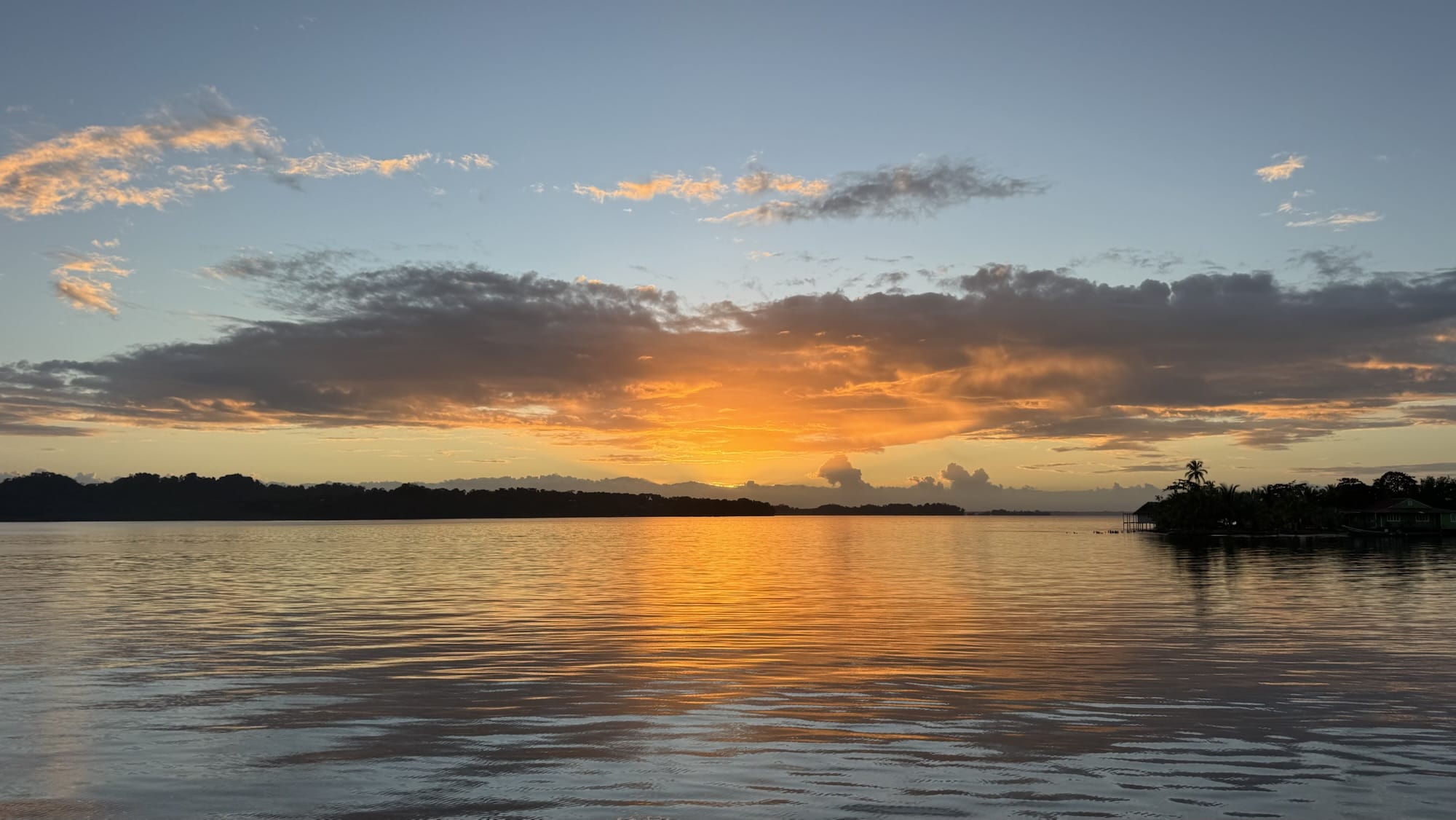
    We truly regretted leaving our new Casa Vela friends, but we’re grateful for the connections we made.

    Francesco and Gabriella
  • Christmas in the Comarca

    Christmas in the Comarca

    I woke up on Christmas Eve morning in a bit of a sour mood. It had been raining and windy all night. I don’t sleep well in bad weather. There’s too much to think about. Did the wind shift? Is the swell building? Is the anchor dragging?

    When the alarm sounded at first light, I got up to make coffee, stumbling over some overflowing stacks of kitchen gear and canned foods in the galley. Although we have squeezed all our remaining belongings onto the boat, we haven’t exactly managed to organize and stow them in a seaman-like manner. Things take up a lot of space on a small boat: tools, spare parts, clothing, food, safety gear—everything we need to live a self-sufficient life at sea. It doesn’t all fit on the boat. I’m constantly annoyed by all the piles, and on this day in particular I was grumpy about having too much stuff.

    The Ngöbe-Buglé Comarca

    On December 23 we sailed twenty miles or so across Laguna Chiriqui to Bluefield, at the end of a peninsula that separates the Laguna from the Panama’s Caribbean “Mosquito Coast.” Bluefield is named for the seventeenth century Dutch privateer and explorer Abraham Blauvelt. 

    Bluefield is part of the Ngöbe-BuglĂ© Comarca. Panama has four comarcas, self-governing indigenous regions. The Ngöbes are the most populous of Panama’s indigenous peoples, numbering about 200,000. Their comarca stretches around the south and east sides of Laguna Chiriqui and along the Caribbean coast. Their native tongue, Ngöbere, is of the Chibchan group of Central American indigenous languages. Families speak Ngöbere at home, but Spanish is used in schools. Grandparents are more comfortable speaking Ngöbere; their grandchildren greatly prefer Spanish. 

    Unlike Bocas del Toro, Bluefield is not a tourist destination. A few cruising boats stop in now and then, but otherwise this part of Panama is isolated. There are no roads. Cayucos (dugout canoes) and a few outboard powered launches are the only form of transportation.

    We had been forewarned. The local Ngöbes are friendly and curious, and they will be at the boat as soon as the anchor is down. We were, in fact, still setting anchor as the first cayucos approached us. The onslaught can be a bit intimidating. They want to check out the spectacle of gringo cruisers. They want to chat. They want to charge their phones (very old, usually with cracked screens) and use our Starlink. They offer whatever they have to sell—bananas, plantains, coconuts, lobsters, guided tours. They ask for things too. Since we knew we would be here for Christmas, we had stocked up on lots of small gifts to hand out to children.

    The first Ngöbe to reach our boat, Enrique, offered to be our local guide.  We agreed that he would come back the next day in a larger cayuco to take us on a tour of the village.

    Feliz Navidad

    And so, on the morning of Christmas Eve, Enrique paddled up to our boat in the Ngöbe version of a family sedan. Joe and I scrambled into the large cayuco and paddled with our guide about half a mile down the bay to a creek. Then we paddled about a quarter mile up the creek, under a canopy of arching tree branches festooned with orchids, bromeliads, and aroids.

    Joe and I paddled this cayuco across the bay with Enrique.

    The cayuco was surprisingly stable and tracked well. Turning the tight bends of the creek was a challenge, but that was possibly due to my lack of steering skill in the bow position. It seems that all cayucos leak, probably from boat worms, so someone has to stop paddling regularly to bail out the bilge water. That was Joe’s job.

    We landed on a muddy bank, waded through the mud to firm ground, then followed a paved footpath through meadows and banana fields until we reached a collection of about a dozen simple wooden huts on stilts. One of these was the home of Enrique’s mother.

    A nicely paved path through meadows and banana fields.
    A cayuco parking space along the creek.
    The “rancho,” a covered community space.
    Homes surrounded by bananas. Enrique’s mother lives in the home on the right.

    We went inside, our first time in an indigenous home. Enrique’s mother held court on a stool in the simple, unadorned space. A newborn baby, her great grandchild, swayed gently in a hammock in the middle of the room, attended by the mother and siblings.

    The great grandmother rules the home.
    Enrique’s nephew; in the background, the baby in the hammock.
    The older folks

    All Our Earthly Possessions

    And that brings us back to my morning funk over having too many possessions. In this home I found myself suddenly ashamed of my earlier foul mood. This home is simple and bare—almost no furniture except a couple of stools. No decorations, no pantry overflowing with food. Cooking implements consisted of a portable propane stove with a single pot on top and a larger Dutch oven over an open fire. Baking is done in the Dutch oven. A piece of metal roofing is laid over the pot, heated by a smoky pile of burning coconut husks. Other than laundry drying on a line outside, there were very few possessions. Lack of storage space isn’t a problem when you have nothing to store.

    Enrique’s cousins.
    Bread cooking in a Dutch oven. A piece of metal roofing is laid on top with burning coconut husks for heat.
    Freshly baked bread.

    We ate a meal of bread and chicha, a cider-like drink made from roasted corn kernels.

    After the meal Enrique led us to a small waterfall. Enrique explained that there just aren’t any paying jobs out here. Life is about fishing and subsistence agriculture. Earning cash locally isn’t an option. The only employment is fifty miles away, harvesting bananas for Chiquita. Getting there by sea in small craft is impractical. The twelve dollars a day they could earn there barely pays for housing in Changuinola, Chiquita’s company town. For people in the Comarca, there are no sources of cash income, and without cash there are no opportunities for advancement. 

    Path to the waterfall.
    The waterfall was not impressive compared to the one we visited on the Rio la Gloria, but there is a spa-like pool just behind where Enrique is standing. Soaking in the warm tropical water was wonderfully refreshing.
    Children ran after us as we paddled away from the village. The suddenly shy boy hid behind his sister as we waved goodbye.

    We paddled the cayuco with Enrique back to our boat. Enrique stayed with us for late afternoon coffee and twilight dinner with a beautiful sunset. We chatted for hours. I live-streamed the Christmas Eve service from my family’s church back in Pennsylvania. My mother was in the pews, my sister in the choir. The pastor spoke of blessings received. On the screen, those blessings were readily apparent in the affluent community of Worcester, Pennsylvania. It was a stark contrast to this village in the Comarca. I felt awkwardly self conscious watching this with our local friend. 

    I thought hard about the history here. The Ngöbes and millions of their indigenous cousins have suffered through half a millennium of European colonization. First the conquistadores killed many of them with germs and steel. Those who survived endured centuries of enslavement, exploitation, persecution, marginalization, and abuse. Today some Ngöbes are Christian and some aren’t, but most live in poverty with little hope of change. 

    Another Day of Visiting

    Enrique came to pick us up again on Christmas Day. This time we went to his home–similar to his mother’s but a little smaller and a little rougher. He lives there with his wife and four children ranging in age from four to seventeen. We enjoyed an afternoon of conversation and playing with the children.

    Enriqu’e son.

    We paddled the cayuco back to the boat that evening after a short rain shower. Enrique’s daughter sat in the bow. The cruising lifestyle provides no shortage of amazing photo ops. They thrust themselves in front of the camera every day.

  • Goodbye to Bocas

    Goodbye to Bocas

    The curse of the cruising lifestyle is that we have to leave a place just when it starts to feel like home. Bocas del Toro–the town and the archipelago– has been our home since June. We had just gotten to the point where we knew which market has the best pineapples, which store our preferred rice. It’s a happy comfort when we can walk through town and run into people we know on almost every block.

    So it was with both sadness and anticipation that we weighed anchor on December 14, exactly six months after we sailed in from The Bahamas. We took a last sail through Tierra Oscura, where we had lunch with friends. Then on to one of our favorite places, Dolphin Bay, for more farewells.

    Great friends at the Dolphin Bay “Yacht Club.”

    New Horizons

    Next we sailed on to Loma Partida, the gateway from the familiar waters of Bahia Almirante to the unknown (to us) waters of the much larger Laguna Chiriqui.

    The pass at Loma Partida, looking onto Laguna Chiriqui.
    Many pretty homes and rental cottages line the shores at Loma Partida.
    The view from Isla Joya in the northwest corner of Laguna Chiriqui.

    We sailed across Laguna Chiriqui to the little town of Miramar on the south shore. Along the coast, the isthmian mountain range rises sharply from the coast.

    Miramar

    Like most places in the Laguna, Miramar isn’t on the usual cruisers’ circuit. Cruising sailboats are a novelty, and the curious, friendly townspeople couldn’t be more hospitable. As we walked past a modest home, the owner, Larry, pulled us in and showed us around. We became fast friends during an hour of chatting. When it was time to go, he cut down about forty pounds of coconuts for each of us–as much as we could carry. He didn’t have much, but he gave generously what he could.

    I think about the traveling I’ve done, especially in the developing world. I’ve experienced nearly universal kindness and generosity from people for whom life is a daily struggle. It makes me sad to know that many of these people, should they ever visit my country, would likely not receive such a warm welcome from my countrymen.

    Continuing through the town, we came to a marvelous gingerbread house on pilings over the water. I stopped to take a picture. The owner, Maria, invited us in. We had a long chat about our families and our travels.

    Maria’s marvelous gingerbread house, decorated for Christmas.
    Maria is a big personality with a big heart.

    By then it was time to find dinner. Locals pointed us toward the restaurant: walk down the road until it ends, then keep going half a mile down a dirt path along the beach. At the path’s end is Oscar’s restaurant. There Oscar and is wife graciously served us homecooked meals on beachside picnic tables.

    The path to Oscar’s.
    Oscar’s restaurant, looking like it belongs in a Brothers Grimm tale.
    Our drinks were coconut water, harvested on the spot from a nearby tree.

    La Cascada

    Our main purpose for sailing to Miramar was to visit a waterfall on the Rio la Gloria. The waterfall is accessible from either of two indigenous Ngobe villages on opposite sides of the river. A villager serves as a guide for a challenging two-hour hike to the waterfall.

    We choose to hike from the Alto la Gloria community. A pickup truck met us in town at the dock. The newly constructed gravel road is one of the steepest I have ever seen. It has a vertical rise of 1300 feet over about a mile and a half for an average grade of 16% by my math. We had to walk the last few hundred yards–going up wasn’t too bad; coming back down was treacherous. This is the only access for a community of several hundred people. Before the road construction this year, they had only a dirt path.

    Photos don’t convey the steepness.
    At the top of the road, the Alto la Gloria community.
    The view spans all of the Bocas del Toro archipelgo and Laguna Chiriqui out to the open Caribbean.

    Our young guide Daniel led us along a challenging mile and a half trail through pastures, banana fields, and rainforest jungle. Every step was jaw dropping–a botanist’s paradise of palms and canopy trees, epiphytes, aroids, ferns, and dozens of plants we we know from our horticultural work.

    Daniel picked a couple of ripe cacao pods from trees along the trail. We have toured a chocolate farm and know how chocolate is extracted from the seeds. Daniel showed us something we didn’t know: the thin white flesh around the seeds is incredibly tasty, what I can best describe as the tartness of a green apple combined with the sweetness of tangerine. You pop a seed in your mouth, suck on the fleshy part, then spit out the seed.

    I’ll let photos tell the rest of the story.

    And finally, a refreshing swim.