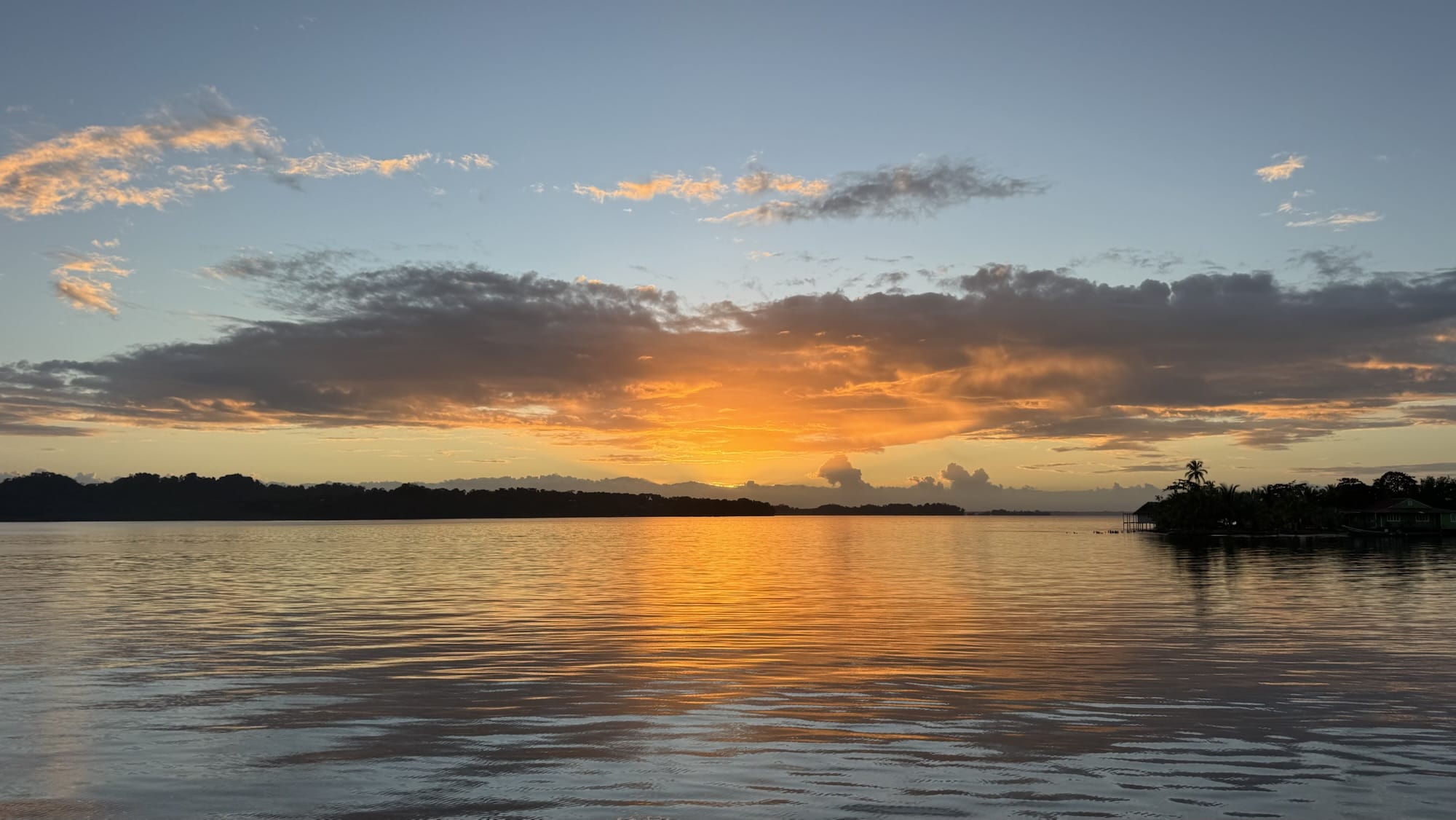
I woke up on Christmas Eve morning in a bit of a sour mood. It had been raining and windy all night. I don’t sleep well in bad weather. There’s too much to think about. Did the wind shift? Is the swell building? Is the anchor dragging?
When the alarm sounded at first light, I got up to make coffee, stumbling over some overflowing stacks of kitchen gear and canned foods in the galley. Although we have squeezed all our remaining belongings onto the boat, we haven’t exactly managed to organize and stow them in a seaman-like manner. Things take up a lot of space on a small boat: tools, spare parts, clothing, food, safety gear—everything we need to live a self-sufficient life at sea. It doesn’t all fit on the boat. I’m constantly annoyed by all the piles, and on this day in particular I was grumpy about having too much stuff.
The Ngöbe-Buglé Comarca
On December 23 we sailed twenty miles or so across Laguna Chiriqui to Bluefield, at the end of a peninsula that separates the Laguna from the Panama’s Caribbean “Mosquito Coast.” Bluefield is named for the seventeenth century Dutch privateer and explorer Abraham Blauvelt.

Bluefield is part of the Ngöbe-Buglé Comarca. Panama has four comarcas, self-governing indigenous regions. The Ngöbes are the most populous of Panama’s indigenous peoples, numbering about 200,000. Their comarca stretches around the south and east sides of Laguna Chiriqui and along the Caribbean coast. Their native tongue, Ngöbere, is of the Chibchan group of Central American indigenous languages. Families speak Ngöbere at home, but Spanish is used in schools. Grandparents are more comfortable speaking Ngöbere; their grandchildren greatly prefer Spanish.
Unlike Bocas del Toro, Bluefield is not a tourist destination. A few cruising boats stop in now and then, but otherwise this part of Panama is isolated. There are no roads. Cayucos (dugout canoes) and a few outboard powered launches are the only form of transportation.
We had been forewarned. The local Ngöbes are friendly and curious, and they will be at the boat as soon as the anchor is down. We were, in fact, still setting anchor as the first cayucos approached us. The onslaught can be a bit intimidating. They want to check out the spectacle of gringo cruisers. They want to chat. They want to charge their phones (very old, usually with cracked screens) and use our Starlink. They offer whatever they have to sell—bananas, plantains, coconuts, lobsters, guided tours. They ask for things too. Since we knew we would be here for Christmas, we had stocked up on lots of small gifts to hand out to children.
The first Ngöbe to reach our boat, Enrique, offered to be our local guide. We agreed that he would come back the next day in a larger cayuco to take us on a tour of the village.
Feliz Navidad
And so, on the morning of Christmas Eve, Enrique paddled up to our boat in the Ngöbe version of a family sedan. Joe and I scrambled into the large cayuco and paddled with our guide about half a mile down the bay to a creek. Then we paddled about a quarter mile up the creek, under a canopy of arching tree branches festooned with orchids, bromeliads, and aroids.

The cayuco was surprisingly stable and tracked well. Turning the tight bends of the creek was a challenge, but that was possibly due to my lack of steering skill in the bow position. It seems that all cayucos leak, probably from boat worms, so someone has to stop paddling regularly to bail out the bilge water. That was Joe’s job.
We landed on a muddy bank, waded through the mud to firm ground, then followed a paved footpath through meadows and banana fields until we reached a collection of about a dozen simple wooden huts on stilts. One of these was the home of Enrique’s mother.


We went inside, our first time in an indigenous home. Enrique’s mother held court on a stool in the simple, unadorned space. A newborn baby, her great grandchild, swayed gently in a hammock in the middle of the room, attended by the mother and siblings.


All Our Earthly Possessions
And that brings us back to my morning funk over having too many possessions. In this home I found myself suddenly ashamed of my earlier foul mood. This home is simple and bare—almost no furniture except a couple of stools. No decorations, no pantry overflowing with food. Cooking implements consisted of a portable propane stove with a single pot on top and a larger Dutch oven over an open fire. Baking is done in the Dutch oven. A piece of metal roofing is laid over the pot, heated by a smoky pile of burning coconut husks. Other than laundry drying on a line outside, there were very few possessions. Lack of storage space isn’t a problem when you have nothing to store.


We ate a meal of bread and chicha, a cider-like drink made from roasted corn kernels.
After the meal Enrique led us to a small waterfall. Enrique explained that there just aren’t any paying jobs out here. Life is about fishing and subsistence agriculture. Earning cash locally isn’t an option. The only employment is fifty miles away, harvesting bananas for Chiquita. Getting there by sea in small craft is impractical. The twelve dollars a day they could earn there barely pays for housing in Changuinola, Chiquita’s company town. For people in the Comarca, there are no sources of cash income, and without cash there are no opportunities for advancement.


We paddled the cayuco with Enrique back to our boat. Enrique stayed with us for late afternoon coffee and twilight dinner with a beautiful sunset. We chatted for hours. I live-streamed the Christmas Eve service from my family’s church back in Pennsylvania. My mother was in the pews, my sister in the choir. The pastor spoke of blessings received. On the screen, those blessings were readily apparent in the affluent community of Worcester, Pennsylvania. It was a stark contrast to this village in the Comarca. I felt awkwardly self conscious watching this with our local friend.
I thought hard about the history here. The Ngöbes and millions of their indigenous cousins have suffered through half a millennium of European colonization. First the conquistadores killed many of them with germs and steel. Those who survived endured centuries of enslavement, exploitation, persecution, marginalization, and abuse. Today some Ngöbes are Christian and some aren’t, but most live in poverty with little hope of change.
Another Day of Visiting
Enrique came to pick us up again on Christmas Day. This time we went to his home–similar to his mother’s but a little smaller and a little rougher. He lives there with his wife and four children ranging in age from four to seventeen. We enjoyed an afternoon of conversation and playing with the children.


We paddled the cayuco back to the boat that evening after a short rain shower. Enrique’s daughter sat in the bow. The cruising lifestyle provides no shortage of amazing photo ops. They thrust themselves in front of the camera every day.


Leave a Reply