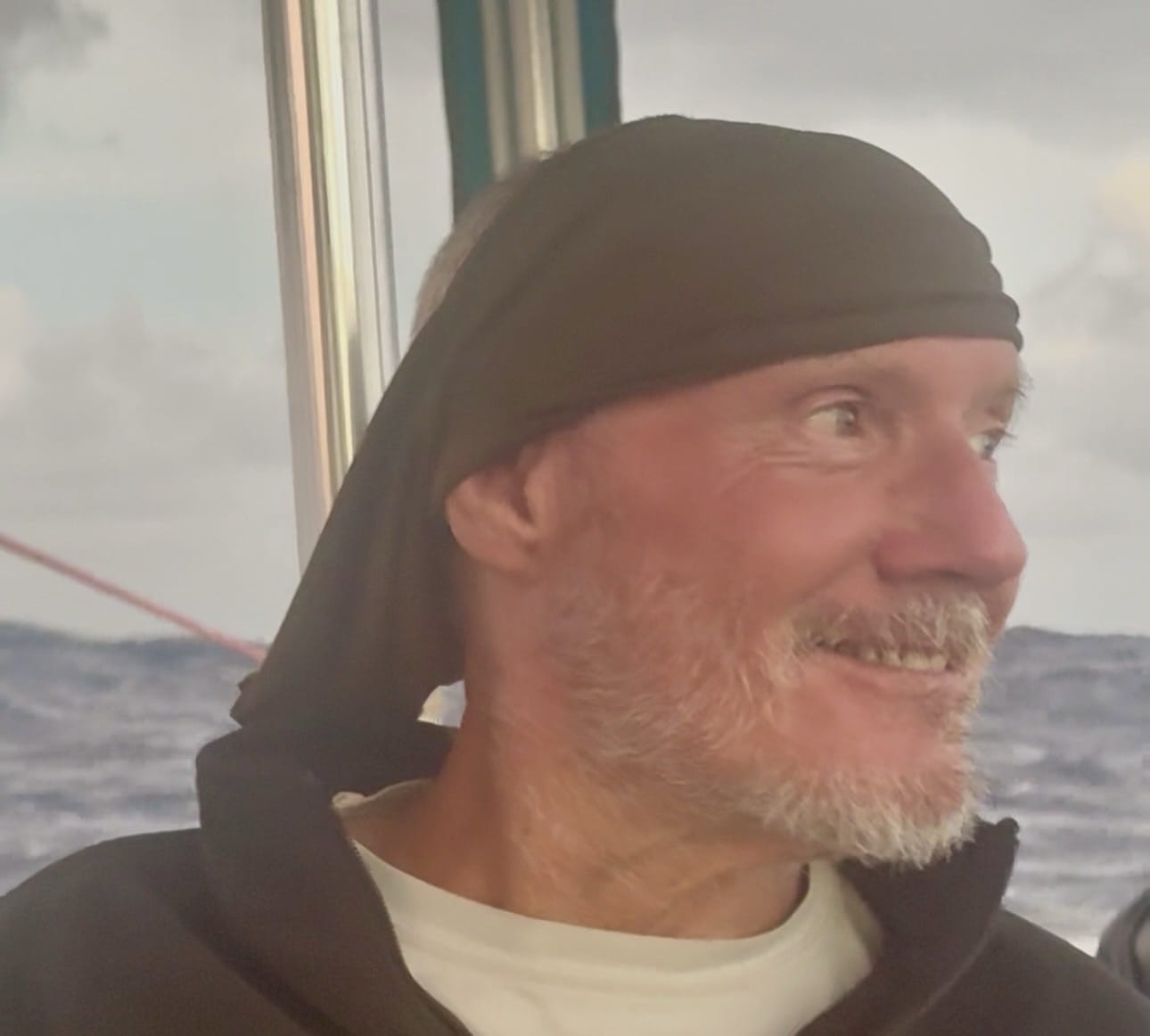
We reached the halfway point yesterday—more than 2,000 nautical miles sailed since we left Panama seventeen days ago. We celebrated with fresh baked brownies and whipped cream.
Boobies continue to entertain us with their posing and preening on the bow.

We made VHF radio contact last night with another sailboat headed our way. We couldn’t see them, but they appeared on our electronic (AIS) system.

We know from social sailing apps that perhaps two dozen other sailboats are on their way westward within a radius of several hundred miles from us. We haven’t seen any of them.
Sailing
Sailing has been brisk. Well developed ESE trade winds are blowing 20+ knots, giving us beautiful broad reach sailing as we head WSW toward the Marquesas. We are sailing under genoa and main, with a preventer rigged on the main. The autopilot steers to 138 degrees apparent, about as far off the wind as we can sail under this configuration in these seas.
We’re approaching 8 degrees south latitude. Hiva Oa, our destination, is at 10 degrees south. That allows us only 120 miles of southing over the next two weeks. With winds expected to back to due east next week, we’ll have to sail the last thousand miles dead downwind, not an easy point of sail.

One option is to tack downwind with main and genoa or Code 0. That would add considerable distance to our journey. Another option is to sail under genoa or Code 0 alone. That would let us sail perhaps 160 degrees apparent, still requiring some tacking, but not as much. Another option is symmetrical spinnaker, which would allow dead downwind sailing. Because of its light construction and somewhat challenging handling, this is our least favorite sail offshore, at night, or where squalls are possible.
A final option, possibly our best bet, is to go wing-and-wing with twin headsails. That could be either genoa and staysail, easy because both are on furlers, or genoa and Code 0 hanked on to the removable forestay. How well our autopilot can steer that in rolly seas remains to be seen. It’s been a stellar performer thus far and isn’t consuming too much power in following seas.
Food Onboard
We have a lot of food on the boat. On the small islands of the South Pacific, selection is limited and prices are high. We stocked up on as much non-perishable food as we could in Panama, enough for 3-4 months at least.
Perishables require considerable thought and attention on a boat. Our small freezer is packed half full with frozen meats. The rest is stocked with enough frozen fruit to supply us with daily smoothies until landfall. Half of the refrigerator is filled with cheeses and condiments. The rest of the space is reserved for leftovers and advance meal prep items.
Our supply of fresh fruits and vegetables is still ample, but rapidly becoming less diverse. We still have two dozen limes—they keep a month or more. We’re down to the last orange. That’s it for fresh fruits, though we have enough frozen, canned and dried fruit to last months. We used the last bell pepper yesterday. The last eggplant is earmarked for curry tonight. The last zucchini will become breakfast bread tomorrow. There are still some carrots in the refrigerator. A dozen small beets need to be used soon. Cabbages are still abundant. A few tomatoes are left. We have enough potatoes and onions to last until landfall.
Zapallo, a squat Central American pumpkin, wins the record for longevity. We’ve kept them onboard unrefrigerated for six weeks or longer. It can be used for sweet or savory dishes much like a butternut squash.

Another long-distance champ is the chayote, a gourd relative. It can be chopped up and used much like broccoli stems. They last easily a month.

Finally, it’s worth mentioning egg storage on a boat. In much of the world, eggs are sold unwashed and unrefrigerated. They will keep this way at room temperature for up to 3-4 weeks. The trick is to turn them over every other day. This preserves the protective barrier on the inside of the shell. We still have about three dozen eggs left. They should be good for at least another week.
Cooking can be a challenge on a boat. Our galley is small and snug, a strong negative on land but a real boon at sea. Moving around is hard when the boat is sailing over 8 foot waves about six times every minute. A small galley reduces the need to do a lot of moving. Having most things within reach makes the chef’s job easier. Narrow spaces make bracing easier. The last thing we want is to be thrown across a large, open space. In our cabins, fortunately, everything is snug and safe.
Time at Sea
Hours we manage to keep track of pretty easily. Rise and set of sun and moon help keep time, as do mealtimes and watchkeeping schedules.
We are physically in the Pacific time zone (GMT -8), but our clocks are still set to Eastern time (GMT -5). That means sunrise is now at 9:00am according to our clocks. Of course we could set our clocks back, but haven’t for fear of shortchanging someone’s sleep. We could just wait to change our clocks until we get to our destination. How’s this for confusing? The time zone in the Marquesas is GMT -9 hours 30 minutes.
Days are much harder to comprehend than hours. We struggle to remember which day of the week it is. Even with writing the day and date once every hour in the logbook, we have a hard time internalizing that today is Tuesday(?) or that Tuesday is in any way distinguished from Sunday, Friday, or any other day.
A luxury of this lifestyle is that it really doesn’t matter.
Day 14: 145 miles
Sailing 7 knots on a broad reach with ESE winds in the mid teens. Mainsail and genoa. Perfect trade wind sailing!
Day 15: 182 miles
Brisk sailing in 20+ knots wind. Seas 2-3 meters.
Day 16: 134 miles
Squalls just before sunset. Sailed through the night with reefed main and genoa.
Day 17: 138 miles
Again, ideal trade wind sailing in perfect weather.
Total to date: 2,045 miles


Leave a Reply