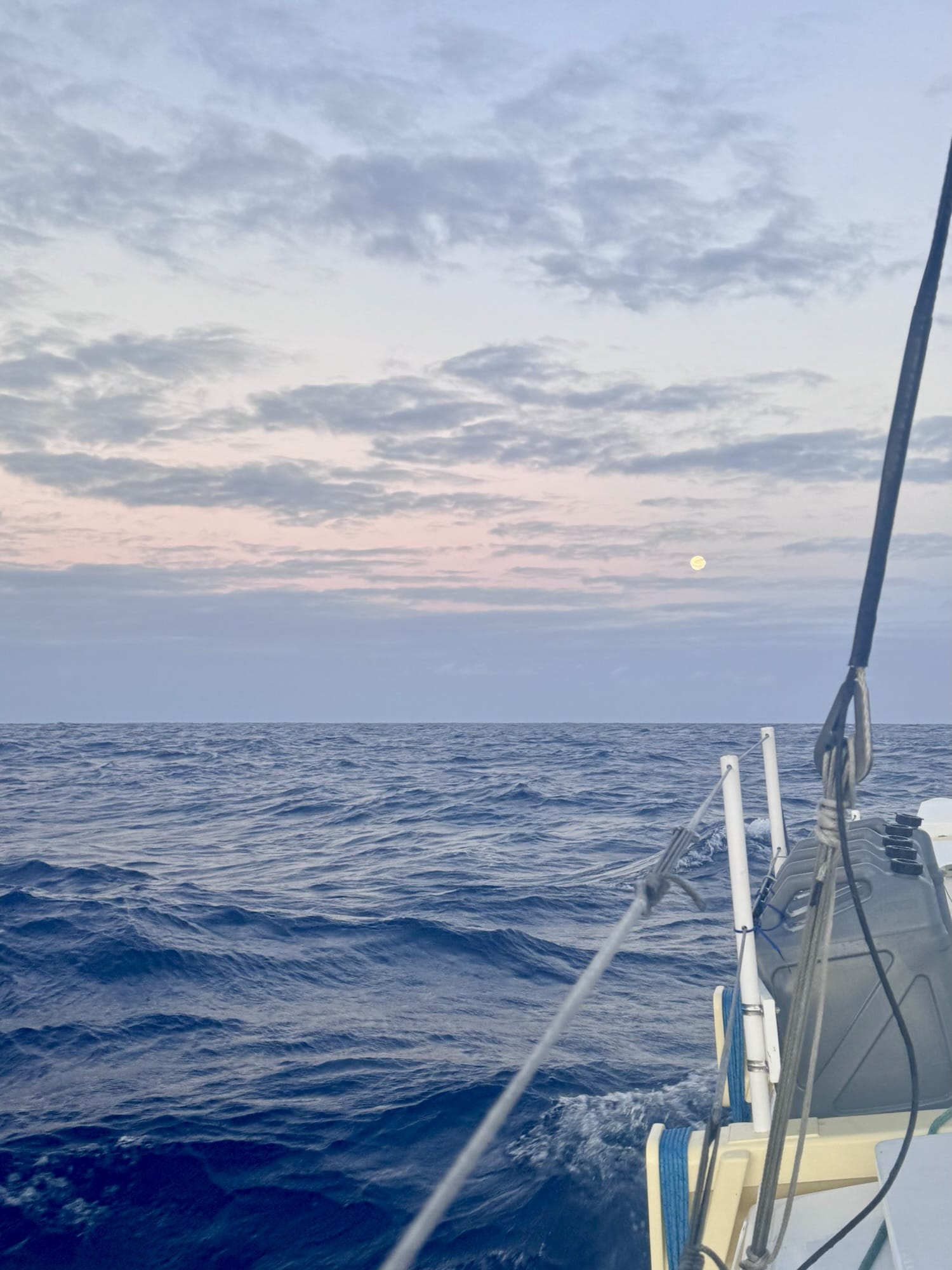
It’s day 24 of our voyage across the Pacific Ocean. We’ve sailed more than 3,000 miles since we left Panama with just under a thousand left to go to our destination in French Polynesia.
This is usually an easy trade wind route, with favorable winds and currents most of the way.
They call this route the “coconut milk run,” and what a delightfully pleasant run it has been for us!
We’re sailing this route somewhat early in the season, before the trade winds are reliably established. We also had to cross hundreds of miles of the doldrums, an area of frequent squalls and slow going, or often no going at all.

Nevertheless we hit the jackpot of sailing conditions, a slow but steady and easy progression through the doldrums and a glorious, near perfect trade wind sail these past two thousand miles. We’ve been on a continuous port tack broad reach since rounding the Galapagos.
We’re not setting any speed records. We sail this boat’s conservative sail plan conservatively. We tuck in a reef whenever there is a risk of squalls, especially at night, and are slow to shake out the reef until we’re confident of prolonged good conditions.
We’ve encountered occasional light rain and a few minor squalls, mostly at night. For the most part we’ve had blue skies, cobalt blue water, heavenly temperatures, steady winds, and gently following seas. It doesn’t get much better than this. Our boat, with its double-ended canoe shaped hulls, handles the following seas with elegant seakindliness. We have to hold on tight and move around carefully when the waves are big, but much of the time the motion is so smooth it feels like we are riding a magic carpet.
Dreaming of Polynesia
Now that we’re in the home stretch, we have been thinking a lot about our destination. Polynesia has enthralled Westerners for centuries with its ruggedly beautiful verdant mountains and valleys, atolls of sparkling blue water, idyllic climate, and famously beautiful inhabitants. (To get a taste of the impression Polynesia made on Western adventurers, Herman Melville’s Typee, a first-hand account of living among the indigenous peoples, is a thrilling read.)
The geography of Polynesia is like no other on the planet. The Polynesian Triangle is a collection more than a thousand islands in the South Pacific with New Zealand at the southwestern corner, Easter Island to the east, and Hawaii at the northern point. The length of each side of the triangle is more than four thousand miles.

The first European to make contact with Polynesia was Álvaro de Mendaña de Neira in 1595. I won’t credit him with discovery, as the islands he found and named the Marquesas had already been inhabited by humans for centuries. Mendana sailed from Peru under the patronage of the Marquis de Canute, the Viceroy of Peru, for whom the islands were named.
By the time of the great explorer James Cook’s Pacific expeditions in the 1770s, the basic geography of Polynesia was well established. Thanks in good part to Cook, it was also basically understood that the inhabitants of the Polynesian islands shared a common genetic, cultural, and linguistic heritage. But that begged the great question of Polynesian origins. Who were these people? Where did they come from? How, why, and when did they come to occupy near every inhabitable island over an area of ten million square miles?
(If you find that question as intriguing as I do, the historiography of Polynesian origins is a fascinating read in Christina Thompson’s Sea People: The Puzzle of Polynesia.)
Drift or Sail?
Nearly everyone knows the story of Thor Heyerdahl’s Kon-Tiki expedition in the 1940s. Heyerdahl attempted to prove the plausibility of a popular theory of the time, that prehistoric explorers set out from South America on primitive rafts and drifted downwind to the islands of the South Pacific. He and his companions made it, barely, to an atoll in the Tuomotus archipelago of French Polynesia.
While this is a compelling adventure story, the premise of a drifting migration from the east contradicts a strong body of cultural, archeological, linguistic, and oral tradition evidence pointing to an origin in Southeast Asia. More recently, DNA analysis conclusively proves an Asian origin of the Polynesians.
But how did they get from Asia to the islands of the Pacific? Heyerdahl managed to drift across the Pacific (after being towed fifty miles away from the coast) thanks to prevailing trade winds and currents—the same forces that are giving us such a pleasant sail today. To get from the Asian continent to the Polynesian islands requires sailing upwind, against the trade winds and prevailing currents, across thousands of miles of open ocean. Western sailors didn’t develop the skills to do that until well into the modern era. These weren’t just random, lucky stunts either. Those early Polynesians managed to reach remote Pacific islands repeatedly in vessels big enough to transport whole villages with livestock.
The ancient Polynesians developed two great insights. The first was a remarkable collection of sensory and analytical skills that enabled them to navigate by sky and water, using and remembering all the clues provided by nature: movement of the sun, moon, and stars; patterns of waves and swell in the water; movements of birds and sea life; the smell of the air.
The second great insight concerned the form of sailing craft. The basic options for primitive, ancient mariners were rafts and canoes. Rafts were understood to be stable on the water but were slow and hard to maneuver. Canoes were fast and maneuverable, but lacked stability, especially in offshore ocean conditions. The ancient Polynesians had this insight: if you take two canoes, hold them separate but parallel with lashed poles, you create a double canoe craft that combines the stability of the raft with the speed and maneuverability of the canoe. This is what we would call a catamaran today.

Catamarans didn’t catch on in the West until the late twentieth century, but they were the critical innovation, along with sensory navigation techniques, that allowed the Polynesians to make the greatest of all migrations, the first major human migration not by foot, but by sea.
Westerners thinking about Polynesian origins had a hard time accepting the double canoe idea. Catamarans had been known in the West for some time. The British were introduced to the idea during their rule of India. The Tamil fishermen of northern India used two-hulled vessels; “catamaran” is the Tamil word for “boat.” Captain Cook found Polynesians using catamarans and other outrigger vessels during his expeditions in the eighteenth century. In 1876 the great American naval architect Nathaniel Herreshoff won the prestigious New York Yacht Club’s race with a catamaran of his own design—though he was later stripped of the prize on the grounds that his catamaran wasn’t a proper yacht.
So by the time of Thor Heyerdahl’s rafting expedition in the mid twentieth century, it was understood that catamarans could be fast and made acceptable craft for coastal fishing, but hardly anyone thought they were sufficiently seaworthy for long, offshore ocean passages.
Polynesian Double Canoes
And that brings the story much closer to home for Joe and me as we sail our James Wharram designed double canoe catamaran across the Pacific.
As a young man in England in the 1950s, James Wharram dreamed of exploring the world. He understood that he would need a boat, but didn’t have the money or skill to buy or build one following the traditional designs and boatbuilding practices of the day. He went looking for a different way to build an ocean-going sailing vessel. He found what he was looking for in a specimen preserved under a glass case in the British Museum in London. It was a twenty-two foot traditional Polynesian double canoe, very much like the kind Captain Cook would have seen in the Marquesas. Wharram believed firmly that if the Polynesians could sail these craft across oceans, so could he. Wharram built a scaled-up, adapted replica of the museum specimen using whatever materials he could scavenge and sailed his Polynesian-inspired catamaran across the Atlantic to Barbados. There, with the help of the famous French sailor Bernard Moitessier, Wharram built another, larger catamaran and sailed it back to England—the first successful trans-Atlantic crossings in catamarans. Wharram had proven the catamaran as a seaworthy form for ocean crossings.
Wharram spent the next sixty years designing and selling plans for Polynesian-style ocean-going catamarans. Thousands have been built over the years and continue to be built today. They are rarely seen in yacht clubs or fancy marinas, but they can be found in many of the world’s remote anchorages.

When Joe and I went looking for a boat to sail around the world, the lore of Wharram’s designs and the offbeat community of Wharram sailors immediately caught our attention. The rugged simplicity and distinctive styling of these designs appealed to us.

So in 2015, when we first formulated our five-year plant to quit work and sail the world, we bought the first full-sized Wharram catamaran that came up for sale within a thousand miles (or so) of our winter base in Florida. That boat happened to be a German-flagged 42-foot “Captain Cook” model named after the Polynesian god Mahuini. The owner had spent twelve years single-handing her around the world. He crossed his own wake in Antiqua on his seventieth birthday and put the boat on the market. It was near the end of March. Joe and I were getting ready to return to Boston to open our nursery business for the spring. We had just crossed the Gulf Stream to Florida after spending the winter in the Bahamas. With the first cellular signal in range near Miami, Mahuini’s for-sale listing popped up on my phone. We immediately flew to Antigua and agreed to buy the boat. Our five year plan was now firmly in motion. (There’s a lot of omitted detail here: how we arranged to get Mahuini from Antigua to Key West; how we sold our current sailboat at the time, the first Windhorse; and how we accomplished all of this in the course of a week so we could open the nursery more or less on time back in Massachusetts.)
Back to the Present
Our boat is inspired by Polynesian prototypes and ideas, but is built of modern materials and is equipped with the latest conveniences and navigation electronics. We have it very easy compared to those ancient Polynesian sailors, sailing their primitive catamarans upwind in difficult conditions without the benefit of even a compass.
Still, as I sit here writing this in the cockpit, on watch, I hear the groaning of the rope lashings that secure crossbeams to our canoe shaped hulls. I think constantly about the early voyages of the Polynesians, and of the way those voyages inspired the boat we are sailing on today. I like to think that our voyage to Polynesia in some small way pays humble homage to the greatest seafaring people in human history.
Day 18: 138 miles
Light rain overnight. Big following seas. At 8 degrees south latitude, running as far off the wind as we can under mainsail and genoa.
Day 19: 164 miles
Brisk broad reach sailing in winds just over twenty knots.
Day 20: 140 miles
Continued brisk broad reaching with genoa and first reef in main.
Day 21: 131 miles
Shook out the reef. East southeast winds near 20 knots under partly cloudy skies.
Day 22: 145 miles
Cloudy skies with convergence zone squalls overnight.
Day 23: 127 miles
Continued cloudy skies but no rain. East southeast winds in upper teens.
Day 24: 127 miles
More of the same.
Total: 3,022 nautical miles


Leave a Reply