We’ve been thinking a lot about the choices we make. Leaving Guna Yala was a hard one. Our choice to linger in Bocas del Toro rewarded us with great explorations of lesser-known spots and enduring personal connections. Our choice to breeze through Guna Yala, where we could have happily spent years, was driven by ambitious plans for the year ahead. The hardest decision of all was to leave the Caribbean, where we could have spent the rest of our lives.
Cruisers talk a lot about circumnavigation, the ultimate goal of many long-range sailors. We’ve avoided using that term. We really don’t care whether we return to where we started. For us, it’s not about achieving a particular destination. It’s more about the process of getting somewhere or anywhere. The path is the goal, as the Buddhists say.
We do have a few objective goals though, and one of them is to cross at least one ocean. Delaying until it’s too late would be a disappointment, so we’re doing it while we can.
Shelter Bay Marina
And so with that goal in front of us, we headed to Colon, stopping along the way in Portobelo to see our friends at Casa Vela.
Colon is the Caribbean terminus of the Panama Canal. Shelter Bay Marina, across the harbor, is the only convenient place to prepare for a southbound canal transit. Although we strongly prefer to anchor out, we booked a slip for several weeks.
There’s an incredible energy at Shelter Bay. Nearly everyone is going to somewhere or coming from somewhere. Provisioning, planning, last minute repairs. I’ve never seen such a concentration of big dreamers actively living their dreams. “When’s your date?” is the question everyone asks. Delivery to a boat of big rented fenders and lines means the date is near—the date to take the world’s greatest shortcut, the Panama Canal.
Oceans Divided
Seventy million years ago, North America was completely separate from South America. Waters flowed freely between the Atlantic and Pacific Oceans. Volcanic activity over tens of millions of years created a chain of islands. By three million years ago, sea level changes turned the island archipelago into an isthmus separating the oceans.
Columbus stumbled upon the isthmus more than five hundred years ago in his search for a shortcut to India. Europeans spent the next four hundred years trying to figure out how to carve out an easier route to the Pacific that doesn’t require rounding the treacherous waters of Cape Horn.
The French made a serious attempt at digging a canal in the late nineteenth century. Logistical challenges and malaria doomed that effort. The Americans tried again beginning in 1903. Understanding that mosquitoes transmit malaria, and taking steps to protect canal workers from mosquitoes, were key to successful construction of the canal. It’s an amazing history. For anyone interested in the Panama Canal, David McCullough’s Pulitzer Prize winning book is a well-researched, accurate history that reads more like a novel.
The weighty history and global economic significance of the canal add to the mystique of the experience.
Preparing for a Transit
Before we started the process, I felt more than a little intimidated by the thought of taking our little boat through the canal. Out in the Gulf Stream and the Caribbean, we stayed far away from big ships. I didn’t like the idea of being packed into a lock next to a ship the size of three football fields.

The best piece of advice routinely offered to sailors preparing for a transit is to go through first as volunteers on another boat. Small boats require a minimum of six people on board for a transit: the captain, an advisor provided by the Canal Authority, and four linehandlers. While it’s possible to hire local linehandlers, many captains seek out volunteers. There’s a WhatsApp group just for matching volunteers to transiting boats in need of crew.
So a few weeks before our own transit date, we offered ourselves as volunteers and hit the jackpot of opportunities aboard Tally Ho, a meticulously rebuilt 1910 gaff-rigged cutter.

Tally Ho won the fabled British Fastnet race in 1927. After a seven year rebuild in Port Townsend, Washington, she is headed back to the U.K. to compete again in the Fastnet on the centennial of her victory. There’s a great YouTube video of Part I of Tally Ho’s transit. I’ll post a link to Part II when it’s available or, better yet, subscribe to their channel. In a crowded field of YouTube sailing channels, this is one of the best.
Our volunteer linehandling experience on Tally Ho demystified the transit process and removed most of the fears we had about the canal. Sharing locks with giant ships wasn’t scary at all; they stay where they’re supposed to be, and we stay where we’re supposed to be. The Tally Ho transit had some complications, but nothing a reasonably competent crew couldn’t handle.
The Team
We hit the jackpot again with our own transit crew. Our friend Tyrone flew in from Florida to help. He’s an incredibly experienced sailor, a professional engine mechanic, and a truly wonderful friend.

We hired an agent, Rogelio, to help with the canal paperwork and logistics. That was money well spent. Rogelio found us two hired linehandlers, Tito and Alex. Tito is the most famous linehandler, known by everyone in the canal. He has made thousands of transits over more than thirty years. He and Alex handled everything with expert skill and rollicking humor.
We also took on a neighbor from the dock, Adrian, who recently purchased a boat in Colon that he plans to take home to Germany. Adrian made more than the required quorum, but Joe and I were grateful to be accompanied by such a competent crew. It made all the difference.

All these people have to be fed, and that was to be my job. There’s a bit of pressure on the cook. Our contract with the Canal Authority requires us to provide hot meals for the advisor. If the advisor isn’t happy with the food on offer, he has the right to order food delivered by tugboat, at great expense to us. It doesn’t help that we had four different nationalities on board with different tastes. I needed to have food ready at all times but never knew how much people would want to eat of what or when.
People ask how much a transit costs. For a boat of our size, it came out to around $4,500 including Canal Authority fees, agent, and two hired linehandlers.
Our Turn
Our date was set for February 23. Our agent instructed us to wait at the Shelter Bay anchorage for the advisor to board. Like most southbound small boat transits, our transit was to take two days with an overnight on a Lake Gatun.

Advisors assigned to small boats are white collar Canal Authority employees who take advisor assignments to earn extra money on their days off. Some are highly effective, others less so. Our Day 1 advisor, Daniel, was superb. He handled all radio communications with the Canal and made sure our crew had clear instructions.


It was close to sunset by the time our turn came to enter the first lock. We pulled into the lock behind an oil tanker and rafted up with our assigned lock mate, S/V One Day.


Three consecutive locks raised us 25 meters (85 feet) to the level of Lake Gatun.
We motored out of the locks to our assigned mooring on Lake Gatun. A pilot boat picked up Daniel, leaving the rest of our crew onboard for a rainy but otherwise peaceful night.

Day II

It took all morning to motor 35 miles across the lake to the locks on the Pacific side. We arrived early afternoon at the Pedro Miguel locks.


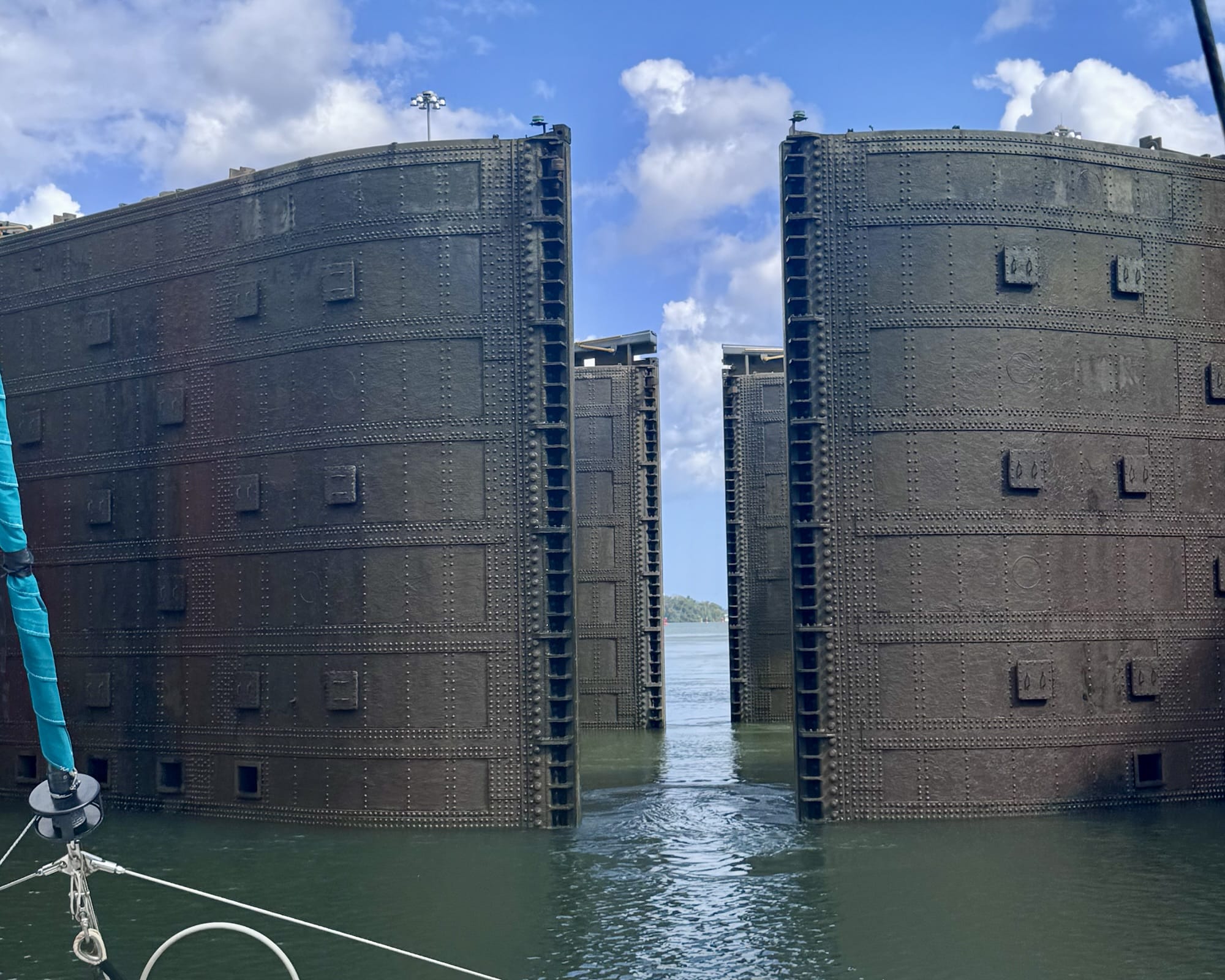
The odd thing about downlocking on the Pacific side is that you really can’t see the locks as you approach. They are already full of water; the gates appear only as the water drains out.

We were behind a big ship when we uplocked the day before. For downlocking, rafted small boats go in first with the big vessels behind us.
After the Pedro Miguel locks, we motored a mile or so to the last two locks, at Miraflores.
Staff ashore throw messenger lines to us for retrieval of mooring lines. The messenger lines have baseball-sized weighted monkey fists at the end. Sometimes the throws are wildly off target. Not this time.

These two guys managed to hit our Starlink dish on both throws. I’m not sure whether that was intentional, but if so their precision was impressive. Fortunately, the dish was unharmed under a protective case.


It’s now mid afternoon on February 24 as we downlock to sea level. Tourists visiting the canal are watching and cheering. Friends and family back home watched the process on a live webcam.


Leave a Reply to Susan OptonCancel reply